


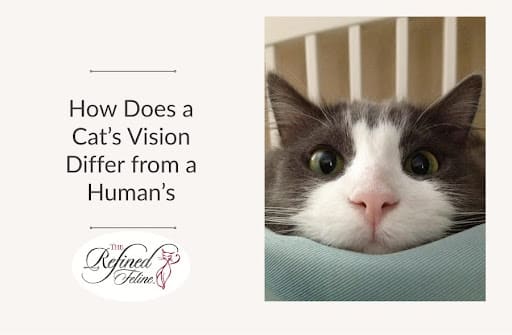
How Does a Cat’s Vision Differ from a Human’s?
TL;DR: Key Takeaways
- Cat vision thrives in dim light, unlike humans.
- Cats see fewer colors but detect motion better.
- Cat eyesight helps guide unique cat behavior like hunting and zooming.
- Their eyes have a reflective layer for night vision.
- They rely more on movement than fine detail.
- Understanding cat vision helps improve playtime and bonding.
You’ve probably wondered why your cat can spot a tiny bug in the dark but walks straight into a chair leg. Or why they stare at “nothing” for minutes. Don’t worry, your cat isn’t seeing ghosts. They’re just viewing the world through a lens very different from yours.
Your cat’s eyes are not just as adorable marbles but as precision instruments built for stealth, motion, and mystery.
What Is Cat Vision Exactly?
The Basics of Cat Eyesight
Cat vision isn’t blurry; it’s specialized. Cats are crepuscular, meaning they’re most active at dawn and dusk. Their eyes are adapted to thrive in low light, where humans struggle to see clearly.
The Science of Cat Eyes
A cat’s eyes contain more rod cells than cone cells. Rods help detect motion and light, while cones help with color. So while humans see rich color in bright daylight, cats excel in dim environments.
How Their Pupils Work
Those dramatic slit-shaped pupils aren’t just for show. They expand widely to pull in every drop of light at night and contract tightly during the day. It’s a built-in night vision upgrade, perfect for silent, shadowy hunts.
Why Cat Eyesight Matters for Cat Behavior
Nighttime Ninjas
Ever wonder how your cat zooms around at 3 AM? Their cat eyesight is six to eight times better in low light than yours. They can spot prey-like movement in near darkness, which explains those late-night zoomies.
Hunters, Not Artists
While humans have vivid, full-spectrum vision, cats see fewer colors. They perceive the world mostly in shades of blue, gray, and muted yellow. This suits hunters better than painters; they’re built for detecting motion, not color contrast.
The Depth Perception Difference
Cats have a wider field of view (about 200 degrees) but slightly weaker depth perception than humans. That’s why they bob their heads before pouncing. It helps them judge distance when stalking toys or unsuspecting feet.
Cat Vision vs. Human Vision
| Feature | Cats | Humans |
| Light sensitivity | Extremely high | Moderate |
| Color range | Blue, gray, muted yellow | Full spectrum |
| Field of view | ~200° | ~180° |
| Depth perception | Slightly less accurate | Strong |
| Night vision | Excellent | Poor |
How Cat Vision Works in Different Conditions
In Bright Light
In daylight, cats actually see worse than humans. Their pupils shrink to narrow slits, limiting light intake. So while your world looks sharp, theirs looks a little washed out. Think “permanent sunglasses.”
In Dim Light
This is where cats shine (literally). Thanks to a reflective layer behind their retinas called the tapetum lucidum, cats recycle light to enhance night vision. It’s why their eyes glow eerily in photos, and why they can spot tiny movements even in near-darkness.
Detecting Motion
Movement is a big deal in cat behavior. Cats are motion-sensitive champions, spotting even the smallest twitch. That’s how they can detect an insect across the room or chase shadows that barely exist.
Cat Vision Superpowers
- Detects motion up to 10 times better than humans
- Sees clearly in just 1/6th the light humans need
- Has a wide visual field for peripheral tracking
- Adjusts focus quickly for fast chases
- Reflects light internally for night vision boosts
Where Cat Vision Differs, or Fails, Compared to Humans
Color Limitations
Humans have three types of cone cells; cats have two. That means they’re partly colorblind, seeing reds and greens as dull or grayish. To them, your bright red sweater might just be a shade of brown.
Blurry Up Close
While cats excel at spotting movement from afar, their close-up focus is weaker. Anything within 10 inches of their face may appear blurry. That’s why they use their whiskers, a built-in GPS for close-range navigation.
Peripheral but Imperfect
Cats see a wider field but can’t focus sharply on the entire range at once. Peripheral vision helps detect threats, but fine detail belongs to humans. So when your cat stares past you, they might just be noticing a flicker you missed.
What This Means for Cat Owners
Adjusting Playtime
Knowing how cat eyesight works helps you tailor play. Use toys that move unpredictably or glow slightly in dim light. Fast motion grabs attention better than bright colors ever could.
Home Environment Tips
Keep lighting soft at night. Cats don’t need bright bulbs to move confidently. Avoid rearranging furniture often, as it can disorient their spatial memory and visual mapping.
Bonding Through Understanding
Understanding cat vision helps explain odd quirks: staring into space, chasing invisible things, or ignoring stationary toys. What looks random to you makes perfect sense in their world of movement and shadow.
Final Thoughts
A cat’s eyes are a map of evolution: tuned for twilight hunts, fast reflexes, and quiet curiosity. Cat vision isn’t better or worse than human sight; it’s just made for different priorities.
Next time your cat gazes into the dark, don’t assume they’re bored. They might just be watching a world you can’t see. And maybe, that’s their secret superpower.
Frequently Asked Questions
Q. Can cats see in total darkness?
Not completely. Cat vision is excellent in low light, but they still need some light to see. Their eyes amplify dim light, which helps them hunt or explore at dawn and dusk.
Q. Do cats see colors like humans?
Not exactly. Cats can see shades of blue and yellow but can’t distinguish red and green. Their world looks softer and more muted, which suits their hunting instincts better than color detail.
Q. Why do cats’ eyes glow in the dark?
It’s because of a special reflective layer called the tapetum lucidum. It bounces light back through the retina, improving cat eyesight in the dark, and creating that iconic glowing-eye effect.
Q. How far can cats see clearly?
Cats see best at middle distances, around 6 to 20 feet. Anything too close or too far becomes fuzzy. That’s why they rely on whiskers and movement rather than precise focus.
Q. Can cats recognize faces like humans?
Not by sight alone. Cats use scent, voice, and behavior to identify people. Their cat vision helps detect movement, but they rely on other senses to bond and recognize you.
Q. Why do cats stare into space?
Their eyes are wired to notice motion and light changes you might miss. When they stare, they’re probably tracking tiny reflections, dust particles, or subtle movements invisible to human eyes.