


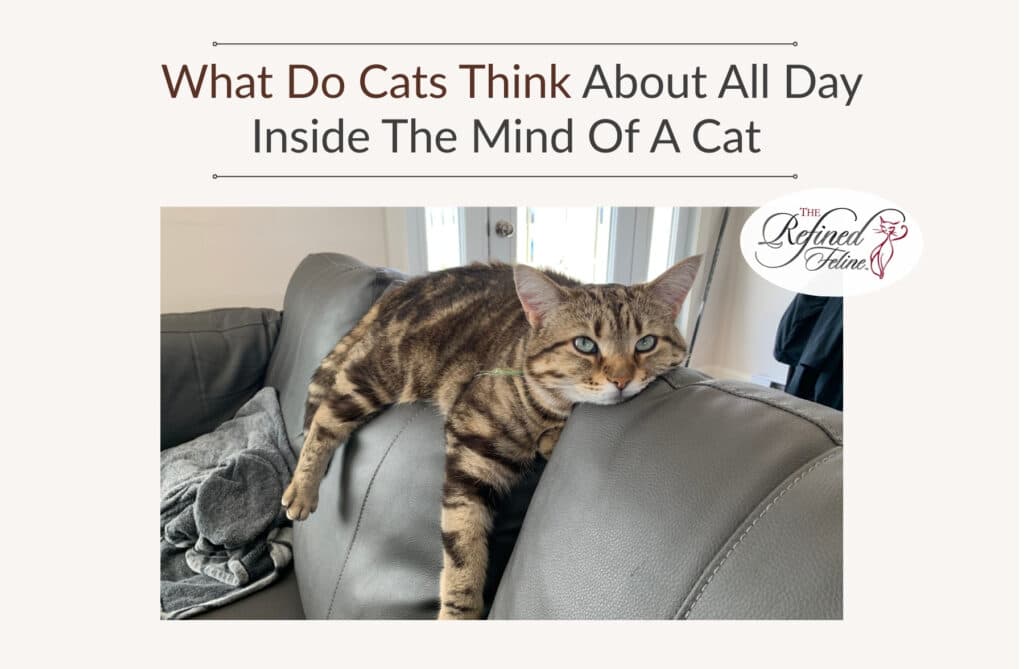
What Do Cats Think About All Day? Inside The Mind Of A Cat
Ever watch your cat stare at a wall for ten minutes and wonder what’s going through their mind? You’re not alone. Cat owners everywhere find themselves puzzling over the inner workings of their feline companions, trying to decode those mysterious gazes and sudden bursts of energy.
Knowing what cats think about can help you create a home environment that truly supports their instincts and needs. While we can’t read their minds directly, science and behavior studies give us fascinating insights into how cats perceive their world and what occupies their thoughts throughout the day.
What Occupies A Cat’s Mind?
Cats spend most of their mental energy on immediate, practical concerns. Unlike humans who might worry about tomorrow’s meeting or next year’s vacation, feline thoughts center firmly on the present moment.
Food ranks at the top of their mental priority list, even for well-fed house cats. Research shows that cats have 300 million cortical neurons, nearly double that of dogs, which helps them stay alert to survival needs. In the wild, a cat that has just eaten must immediately start planning the next hunt to avoid starvation. Your domestic cat carries those same instincts, constantly aware of meal timing and food location.
Beyond food, cats think about:
- Territory monitoring: tracking who and what enters their domain.
- Hunting opportunities: even the flicker of a shadow can trigger predatory focus.
- Rest and comfort: seeking the perfect perch or hiding spot.
- Social connections: including their relationship with you.
- Safety assessment: continuously evaluating their environment for threats.
Giving your cat appropriate spaces for these activities matters. Modern cat furniture provides vertical territory to monitor, comfortable perches to rest, and elevated hideaways that satisfy their instinctual need for safe observation points.
Check Our – Modern Cat Trees, Towers & Condos
How Cats Process Information
Cats don’t think in words or have an internal monologue like humans. Instead, their thoughts come as sensory impressions, memories, and immediate reactions to stimuli.
Your cat possesses powerful long-term memory, especially for experiences linked to strong sensory input. Years later, cats can remember specific people, places, and events. When your cat recognizes a friend who visited months ago, that’s their remarkable memory at work.
Cats also understand object permanence better than many animals. If your cat watches you hide treats in a cabinet, they’ll remember exactly where you put them and return to that spot later. In a 2016 study, researchers found that cats explored bowls where they previously couldn’t access food, showing they retain clear memories of frustrating experiences.
However, cats lack the brain structure for abstract reasoning. Your cat won’t plan elaborate schemes or hold grudges. What might look like revenge after you bathe them is simply an immediate emotional response, not calculated payback.
Your Cat’s Daily Mental Roadmap
Domesticated cats typically sleep 12 to 16 hours daily, most active during dawn and dusk when their wild ancestors would hunt. But what fills their waking thoughts?
During active hours, your cat’s mind focuses on:
- Investigating interesting sounds, smells, or movements.
- Engaging hunting instincts through play.
- Grooming and self-maintenance.
- Seeking interaction or affection from household members.
During rest periods, cats aren’t necessarily thinking much at all. Light sleep allows them to stay semi-alert to environmental changes, while deeper sleep likely involves processing memories and experiences.
During observation time, which cats excel at, they’re mentally cataloging their environment. A cat perched on a wall-mounted cat shelf, scanning the room, is actively thinking about everything in their territory, noting any changes from the last time they looked.
What Cats Think About You
Your cat definitely thinks about you, possibly more than you realize. When your cat greets you at the door after work, you were likely on their mind while you were away.
Behaviorist John Bradshaw suggests that cats view their owners as large, non-hostile cats rather than a different species entirely. Some experts believe domestic cats perceive their owners as parental figures, similar to how kittens view their mothers. Your cat may not understand you’re human, but they recognize you as an important member of their social group.
Cats also form emotional attachments and can read your emotional state. When you’re stressed, your cat might seek you out or keep their distance, responding to your energy.
Interestingly, cats believe they can control you. Purring, rubbing against your legs, and strategic meowing are behaviors your cat has learned that will get results. From their perspective, these actions work remarkably well to make you provide food, open doors, or give attention.
What Cats Don’t Think About
Knowing what doesn’t cross a cat’s mind can be just as helpful as knowing what does.
Guilt: When your cat knocks over a plant and looks at you with wide eyes, that’s not guilt. Cats lack the cognitive framework for remorse. What you’re seeing is confusion or fear, not acknowledgment of wrongdoing.
Revenge: Cats live too much in the present to hold grudges or plot revenge. An “accident” on your bed after you scolded them is more likely stress, anxiety, or a medical issue than calculated retaliation.
The future: Your cat can’t imagine scenarios that don’t exist yet. However, they can predict outcomes based on experience. When your cat hides at the sight of their carrier, they’re remembering past trips, not imagining future ones.
Abstract concepts: Cats don’t ponder the meaning of life, think about death, or understand time as we do. Their world is sensory and immediate.
Check Our – Cat Litter Box Products
Creating an environment that respects how cats actually think makes for a happier companion. Cat condos and towers that offer vertical space, hiding spots, and scratching surfaces address the real concerns occupying your cat’s mind: territory, safety, comfort, and the satisfaction of instincts.
FAQs
Do cats think about their owners when alone?
Yes, cats likely think about their owners, especially around feeding times or when something in the environment reminds them of you. Cats form strong attachments, and your presence becomes part of their mental map of their territory and routine.
Can cats understand what we say to them?
Cats don’t understand language, but they associate specific sounds and words with outcomes. Your cat knows their name and certain commands because they’ve linked those sounds to food, play, or attention, not because they comprehend English.
Do cats get bored when home alone?
Cats can experience boredom, especially in under-stimulated environments. Providing vertical spaces, window perches, interactive toys, and engaging cat furniture helps keep their minds occupied when you’re away.
Why does my cat stare at nothing?
Your cat isn’t staring at nothing. Cats have superior hearing and vision compared to humans. When your cat stares at a wall, they’re likely detecting subtle sounds, tiny movements, or tracking light changes you can’t perceive.
Do cats recognize themselves in mirrors?
Cats don’t pass the mirror self-recognition test. When a cat sees their reflection, they likely thinks it’s another cat, though they may lose interest when it doesn’t smell or respond like one.